
Commercial Roof Replacement in Lansing
Lansing, Michigan
When a Lansing Roof Stops Being a Repair and Becomes a Replacement
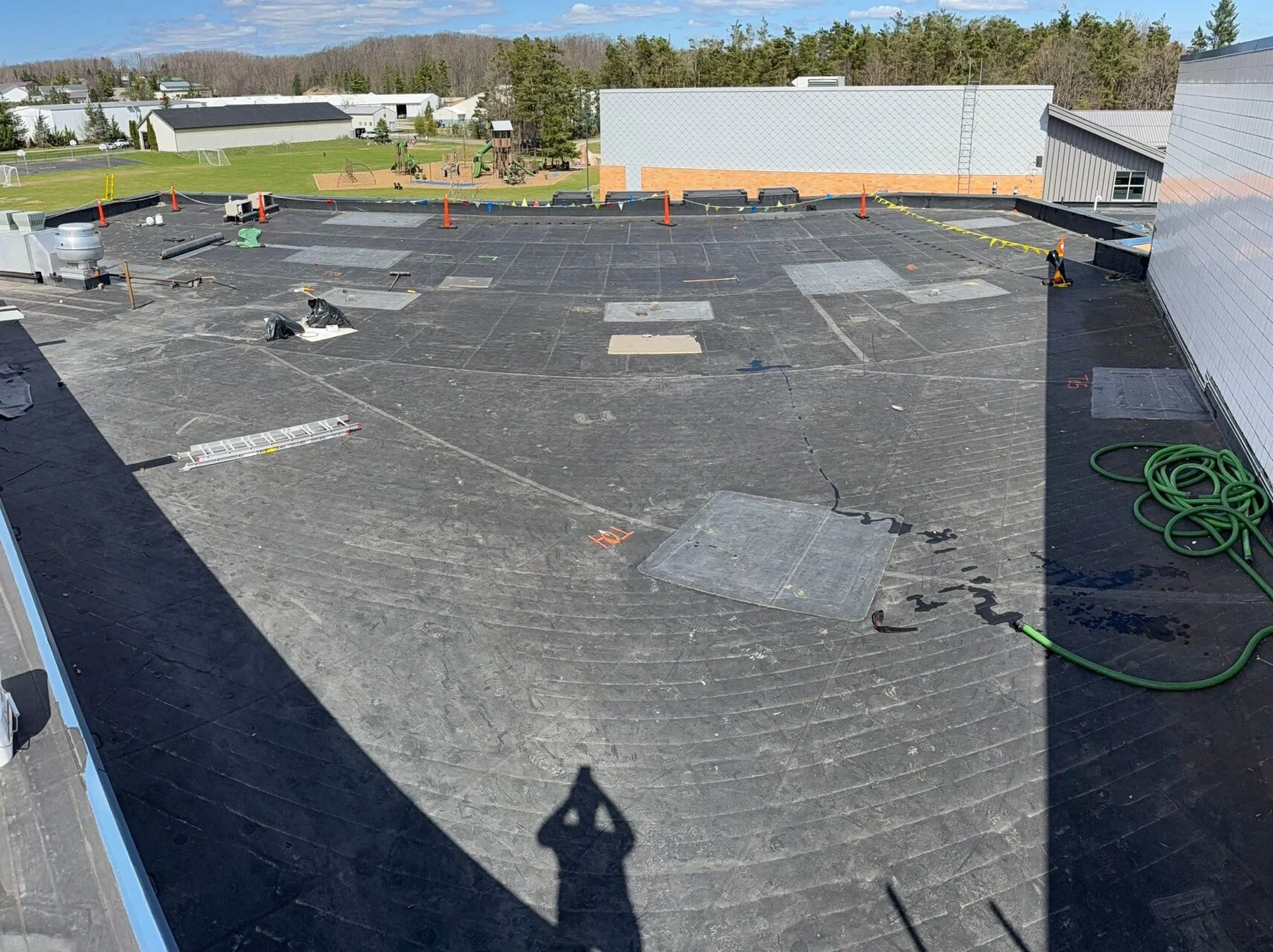
The replacement plan explains tear-off or recover assumptions, insulation and drainage needs, occupied-building phasing, system options, and closeout requirements. Every commercial roof reaches a point where another round of patching costs more, over a shorter window, than a planned tear-off and replacement. The hard part for most owners is knowing which side of that line their roof is actually on, before the decision gets made for them by a leak during a January thaw.
The Signs We Look For Before Recommending Replacement
Deck deterioration is the clearest signal. Once probing finds soft or delaminated deck under the membrane, no coating or recover system fixes that, and the structural question has to be answered before anything else gets specified. Multiple membrane layers already stacked on the deck is the second signal, since most jurisdictions cap how many layers can stay in place, which forces tear-off regardless of the top layer's condition.
Wet insulation spreading across more than isolated zones is the third. A moisture scan that shows saturated insulation in scattered spots across a large roof area tells us the water is not coming from one bad flashing detail, it is coming from age and accumulated seam failure across the whole system.
Structural Load Before Anything Else Gets Priced
Before we price a new assembly, the deck's load capacity has to be checked against the weight of what we are proposing to put on it: new insulation, cover board, membrane, and any drainage improvements the roof needs. On older GM plant buildings and pre-1980s state office structures around downtown, that structural check sometimes changes the whole assembly design rather than simply confirming it.
Michigan's energy code also plays into that number. If the current insulation does not meet today's minimum R-value for roofs over conditioned space, a permit may require added thickness, which adds deck load and reshapes the tapered insulation plan around every drain on the roof.
Tear-Off Logistics on an Occupied Building
Sequencing is where a replacement project either stays on schedule or does not. We break the roof into sections sized to what the crew can tear off, dry in, and close out in a single work day, so no section is left exposed overnight to a surprise Lansing thunderstorm or an early-season snow squall. Winter cuts that window shorter, which is why a replacement scoped in July has more flexibility than one that has to run into November.
Disposal planning matters more than owners usually expect. A full tear-off on a large plant or campus building generates enough debris that dumpster staging and truck routing have to be worked out with facilities and security before demo starts, not during it.
What the Replacement Plan Should Specify
A tear-off and replacement scope that protects the owner through construction typically covers:
- Deck repair pricing set as a unit cost, not an open allowance
- Insulation thickness confirmed against current Michigan energy code minimums
- A temporary dry-in plan for each section in case weather moves in faster than forecast
- Rooftop equipment coordination for anything that has to be lifted, braced, or reset
- Perimeter and edge metal detailing matched to the building's wind exposure
- Final closeout documentation the owner can hand to a future capital planner
Skipping any one of those items is usually where a replacement project runs into a dispute after the fact.
What This Costs an Owner Who Waits Too Long
Deferring a replacement past the point where the deck is already compromised does not save money, it moves the cost into emergency repair, interior damage, and tenant or operations disruption instead of a planned project. We have walked roofs where a manageable replacement six months earlier turned into deck reconstruction plus interior remediation because the owner kept approving patch requests instead of a full assessment.
The math rarely favors waiting. Emergency mobilization, expedited material, and interior repair for damaged ceilings, insulation, or inventory almost always cost more than the same scope handled as a planned project with normal lead times. We put that comparison in front of an owner in plain terms, because a capital budget decision made under emergency pressure is a worse decision than the same one made with six months of runway.
Replacement Questions From Facility and Property Managers
How do you decide between deck repair and full deck replacement?
We probe the deck in a grid pattern during the survey. Isolated soft spots can often be repaired in place; widespread delamination or rot usually means replacing full deck sections is cheaper than chasing repairs one at a time during tear-off.
Does a full tear-off always cost more than a recover?
Upfront, yes, but a recover over compromised insulation or a deck that needs repair is not actually an option, it just defers the same tear-off to a later date with more damage attached to it.
How much notice do we need before a replacement project can start?
Enough time for the survey, the bid process, and material lead times, which for named manufacturer systems can run several weeks depending on the season. We give owners a realistic timeline once the scope is set.
Can you replace a roof section by section instead of all at once?
Often yes, especially on large plant or campus roofs where budget or occupancy makes a single mobilization impractical. We phase those projects with clear boundaries between completed and pending sections so the roof stays watertight at every stage.
What happens if the deck condition is worse than the initial survey found?
That is exactly what unit pricing in the bid is for. We document the additional condition with photos and measurements, price it against the pre-agreed unit rate, and get owner sign-off before proceeding rather than treating it as a surprise invoice.
Ready to review the roof scope?
Related Commercial Roofing Services
-
Standing Seam Metal for Distribution and Plant Buildings
View project -
Repairing Lansing Roofs After Wind, Ice, and Derecho Damage
View project -
TPO Roofing for Lansing's State and Auto-Plant Buildings
View project -
Acrylic Coatings: The Right Tool When Ponding Isn't the Problem
View project -
Legacy Gravel Roofs Still in Service Downtown and on Campus
View project -
State Office Towers and Century-Old Downtown Roofs Answer to Different Rules
View project